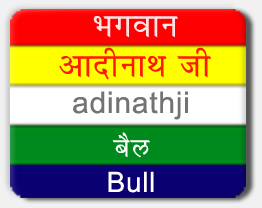
Life & History
According to Jain tradition, Rishabhanatha was born to King Nabhi and Queen Marudevi in the ancient city of Ayodhya (also called Vinita), the capital of the Ikshvaku dynasty. He is said to have had two wives, Sumangala and Sunanda, and many children, including his sons Bharata and Bahubali, who feature prominently in later Jain narratives.
Jain texts describe him as the one who guided early human society away from a primitive state of nature by teaching essential arts and skills: agriculture, pottery, writing, weaving, and other crafts, as well as the organization of society into occupational groups. For this reason he is often regarded as a civilizational figure, distinct from the other Tirthankaras whose accounts are more purely spiritual and symbolic.
After ruling as a king, he renounced worldly life, undertook rigorous asceticism, and attained kevala jnana (omniscient knowledge), becoming a Tirthankara — a "ford-maker" who shows others the path across the cycle of rebirth. His life is recounted in detail in the Adi Purana, a major Jain text composed by Acharya Jinasena.
Rishabhanatha's era belongs to the vast, cyclical time-scale of Jain cosmology, placing him far beyond the reach of conventional historical dating, yet Jains regard him as a real and foundational figure whose teachings shaped the moral and social order.
Teaching & Significance
Like all Tirthankaras, Rishabhanatha taught the path of ahimsa (non-violence), right conduct, and renunciation leading to liberation, while also being credited with establishing the practical foundations of civilized life.
At a Glance
- Position
- First of twenty-four
- Emblem (Lanchhana)
- Bull
- Traditional colour
- Golden
- Moksha Sthal
- Mount Kailash (referred to in Jain tradition as Ashtapada)