Life & History
Mallinatha belongs to the earlier, more legendary portion of Jain sacred history, from an age when Tirthankaras were said to live for extraordinarily long spans. Little can be independently verified about this period, and the account is best understood as part of Jain cosmological tradition rather than recorded history.
Jain tradition places the birth of the nineteenth Tirthankara in Mithila, a city long associated with Jain and other Indian religious narratives. As with the other Tirthankaras of this early era, the surviving accounts are preserved mainly through later canonical and narrative literature.
As noted above, the two major Jain traditions differ on this Tirthankara: the Shwetambar tradition holds this Tirthankara was born as a princess, Malli Kumari, while the Digambar tradition holds that all twenty-four Tirthankaras were male. Both traditions agree on Mallinatha's place among the twenty-four and on the substance of the teaching associated with them.
Mallinatha is traditionally counted among the Tirthankaras who renounced the world at a young age after witnessing the impermanence of worldly attachments, going on to preach the path of liberation before attaining moksha.
Teaching & Significance
Mallinatha's teaching, like that of the other Tirthankaras, centered on renunciation of worldly attachment and the pursuit of liberation through right faith, right knowledge, and right conduct.
At a Glance
- Position
- 19th of twenty-four
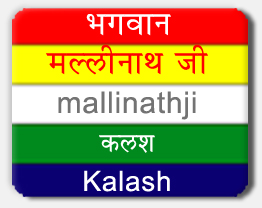
- Emblem (Lanchhana)
- Water Pot (Kalasha)
- Traditional colour
- Blue
- Moksha Sthal
- Sammed Shikhar (Parasnath Hills, Jharkhand)