Life & History
Neminatha occupies a distinctive place among the Tirthankaras because Jain tradition links his life directly to the Yadava clan and to Krishna, a figure central to wider Indian religious tradition. He is described as a prince of the Yadavas, born into the same extended lineage as Krishna and counted as his cousin, at a time when the Yadavas, under Krishna's leadership, are said to have relocated from Mathura to Dwaraka in Saurashtra (Gujarat) after conflict with Jarasandha.
The best-known episode of his life concerns his renunciation. He had agreed to marry Rajimati (Rajul), and as the wedding procession approached the bride's home, he heard the anguished cries of animals gathered to be slaughtered for the wedding feast. Moved to deep compassion, he turned back before the marriage could take place, gave up his royal ornaments and princely life, and departed to pursue asceticism, choosing complete non-violence over the marriage.
He is traditionally said to have undertaken intense meditation and austerity on Mount Girnar (Girnarji) in present-day Gujarat, where he attained Kevala Jnana (omniscience). Mount Girnar subsequently became, and remains, one of the most important Jain pilgrimage sites, closely identified with Neminatha.
Neminatha is traditionally held to have later attained moksha on Mount Girnar itself, making the mountain sacred to Jains both as the site of his enlightenment and his liberation. His association with Krishna and the Yadava-Dwaraka narrative gives his story a distinctive place bridging Jain and broader Puranic tradition, and Rajimati's own subsequent renunciation is also remembered in Jain literature.
Teaching & Significance
Neminatha is especially remembered for his uncompromising commitment to ahimsa (non-violence), renouncing marriage itself rather than be party to the killing of animals for a wedding feast.
At a Glance
- Position
- 22nd of twenty-four
- Emblem (Lanchhana)
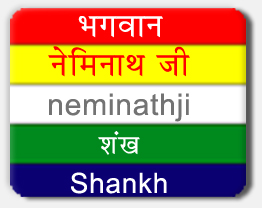
- Conch (Shankha)
- Traditional colour
- Black
- Moksha Sthal
- Mount Girnar (Girnarji), Gujarat